The Navigator Archetype
The Navigator
The Navigator builds authority by making complexity legible. Recognise this archetype, its shadow, and what it means for your positioning.
By ianka fleerackers · Updated 25 May 2026
Some professionals are the person everyone turns to when the room is confused. Not for a decision — for a frame.
They see patterns across disciplines, translate complexity into language others can act on, and create structure where none existed. Their authority does not come from being first or being fastest. It comes from being the one who makes things clear. This is what building authority through sense-making and structure actually looks like: not bold predictions, but the capacity to make complexity legible.
If people consistently describe you as “the one who finally made it make sense,” you may carry the Navigator signal — one of the archetypes in the Authority Archetype Mix™ I developed inside the O.W.N® practice.
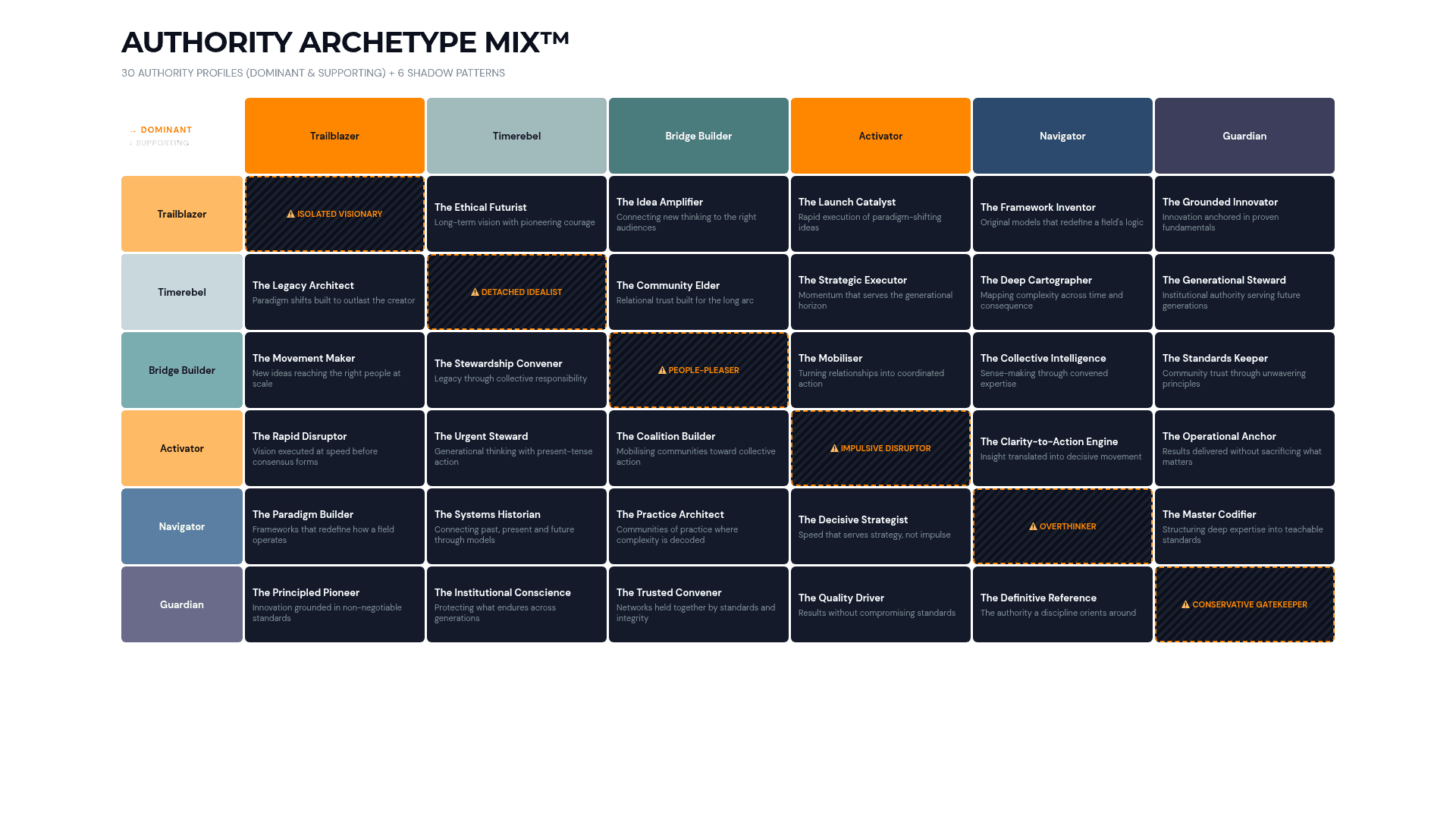
The Navigator builds authority through sense-making. Their signal is cognitive. They see patterns others miss, translate complexity into structure, and guide people toward insight and direction. Their authority grows through the frameworks they create and the decisions they clarify.
How the Navigator builds authority through sense-making
The Navigator's authority is built on interpretive power. They produce frameworks, guides, and deep-dive analyses. Their writing is structured, precise, and often educational. On stage, they deliver with calm confidence, making abstract ideas concrete through examples and models. Their influence attracts professionals who need understanding before action — the kind of audience that values intellectual depth over motivational energy.
The Navigator is often the most underestimated archetype. Their authority is quiet, structural, and cumulative. It does not announce itself. It accumulates until the Navigator becomes the reference others cite — a different source of standing than the Trailblazer who shifts a paradigm or the Activator who drives immediate momentum.
A Navigator in practice
Elena was a senior HR consultant who had spent fifteen years helping organisations navigate restructurings. She knew more about how change actually works inside companies — not the theory, the reality — than almost anyone in her field. But her public positioning said “HR consultant,” and that put her in a category with thousands of others.
When she attempted thought leadership, she looked at what the Trailblazers in her industry were doing: provocative opinions about the future of work, bold predictions about AI replacing HR, contrarian takes designed to generate debate. She tried producing similar material. It attracted attention but the wrong kind — people who wanted hot takes, not people who needed her expertise.
Elena's actual authority was not in provocative opinions. It was in her capacity to take a chaotic reorganisation and make it legible — to show a leadership team the pattern they could not see, to translate political complexity into a decision framework they could follow. She was a Navigator. The frameworks she developed inside client organisations were genuinely original, but she had never published them because they did not look like “thought leadership.” They looked like thinking.
Once she started publishing the frameworks — not as hot takes but as structured sense-making — her authority shifted. She became the person other consultants cited. The speaking invitations changed: instead of panel debates, she was asked to deliver workshops where executives needed to understand something specific. Her authority compounded because it was finally built from her actual signal.
The shadow: the Overthinker
The Navigator's shadow is the Overthinker — getting trapped in analysis, endless refinement, and the belief that the framework needs one more iteration before it is ready. The Navigator who cannot stop refining produces understanding for themselves but never shares it. Their authority stays private.
The shadow also shows up as difficulty motivating immediate action. When your authority is built on understanding, you can explain the situation with perfect precision and still leave the room without a decision. The Navigator without an Activator or Trailblazer as supporting signal risks being respected but not followed.
The Navigator in the mix
No one carries a single archetype. Authority is a mix, and the Navigator rarely operates alone. It is the structural signal that gives shape to whatever it pairs with — and the pairing determines how the authority is built.
Three pairings recur most often.
Navigator + Activator
Structure + executionTranslates insight into decisive action. The Navigator makes the situation legible; the Activator turns that understanding into movement. This pairing closes the gap between insight and doing — the room not only sees the pattern, it leaves with a decision made.
Navigator + Trailblazer
Structure + visionCreates original frameworks that redefine a field. The Navigator builds the structure; the Trailblazer pushes it past the existing paradigm. Together they produce work that is both genuinely new and genuinely usable — vision that holds because it is built on a frame others can follow.
Navigator + Guardian
Structure + standardsBecomes the definitive reference in a discipline. The Navigator codifies the thinking; the Guardian holds it to a standard. In fields where rigour matters — law, medicine, finance, the sciences — this is the pairing that produces the work everyone else cites.
The Navigator is also the archetype most frequently confused with others. Many professionals who carry this signal aspire to be Trailblazers — mistaking the desire for original thinking, which the Navigator already does, for the desire to disrupt, which is a different signal entirely. The distinction is precisely what the Congruence Wheel™ surfaces inside the Authority Brand Blueprint.
What this means for your authority
If the Navigator is your dominant signal, your authority architecture should be built around the frameworks and models you create — published methodologies, structured analyses, intellectual property that codifies your expertise. Not the bold prediction. Not the contrarian thread. The structure others adopt.
Your narrative should lead with the complexity you make legible, not with bold predictions. Your body of work compounds through the structures others adopt — and it travels, because a framework that earns adoption carries your authority into rooms you will never enter yourself.
The cost of getting this wrong is Elena's cost: years of genuine original thinking left unpublished because it did not look like thought leadership, while the authority you actually carry stays unnamed and unbuilt. Building from the archetype you genuinely hold is not a smaller ambition. It is the only one that compounds.
The next step
The Authority Archetype Mix™ is one of the proprietary tools inside the O.W.N® Practice. It is used in the Authority Brand Blueprint — the foundational program for professionals ready to build authority from the signal they already carry.
If you recognise the Navigator in yourself — or suspect you have been performing someone else's signal — the Authority Mindset Audit is the place to begin. A €47 diagnostic that maps where you currently stand across the dimensions of professional authority. It takes thirty minutes. The results arrive in five.
Take the Authority Mindset Audit →Common Questions
Questions about the Navigator
- What is the Navigator authority archetype?
- The Navigator is one of the signals in the Authority Archetype Mix™ I developed inside the O.W.N® practice. Its authority is cognitive and structural: the Navigator builds authority by making complexity legible — seeing patterns others miss, translating them into frameworks, and guiding people toward insight and direction. Their authority accumulates through the structures others adopt.
- How do you build authority through sense-making?
- By making complexity legible, not by being the loudest. The Navigator builds authority through sense-making — producing frameworks, guides and structured analyses that turn chaos into something others can act on. The authority is quiet and cumulative: it does not announce itself, it accumulates until the Navigator becomes the reference others cite.
- What is the shadow of the Navigator?
- The Overthinker. Getting trapped in analysis and endless refinement — the belief that the framework needs one more iteration before it is ready. A Navigator who cannot stop refining produces understanding for themselves but never shares it, so their authority stays private. The shadow also shows up as difficulty motivating immediate action.
- What is the difference between a Navigator and a Trailblazer?
- A Trailblazer's authority comes from disrupting — bold ideas that shift a paradigm. A Navigator's authority comes from structuring — making an existing paradigm legible. Many Navigators mistake their gift for original thinking, which they already do, for a desire to disrupt, which is a different signal entirely. Performing the wrong one attracts the wrong audience.
The Authority Archetype Mix™ is a proprietary framework owned by ianka fleerackers CommV, built on and used inside the O.W.N® practice — Ownership, Wisdom, Narrative — a registered trademark of ianka fleerackers CommV. Unauthorised use, reproduction or adaptation of this framework or methodology is prohibited.
© 2026 ianka fleerackers CommV. All rights reserved.