The Trailblazer Archetype
What Thought Leadership Actually Means
Thought leadership has become the most diluted term in professional positioning. The Trailblazer archetype reveals what it actually requires — and why most professionals who claim it are operating from a different signal entirely.
By ianka fleerackers · Updated 25 May 2026
The term “thought leader” has lost its meaning. To understand what thought leadership actually means, you have to separate the work from the performance of it.
It has been stretched so thin that anyone who publishes regularly, speaks at a conference or develops a methodology now claims the title. The result is a landscape where the term signals nothing — where a consultant who shares industry commentary occupies the same category as someone whose work fundamentally changed how an entire field operates.
That conflation is not just imprecise. It is costly — to the professionals who genuinely hold this form of authority, and to the ones who perform it without carrying it.
In the work I do through the Authority Archetype Mix™, the Trailblazer is the archetype that corresponds to what thought leadership was originally meant to describe. Not someone with good ideas. Not someone who publishes frequently. Someone whose work shifts a paradigm — who changes how a field thinks, operates or understands itself. That is a fundamentally different claim than “I have expertise and I share it publicly.”
Why the confusion runs so deep
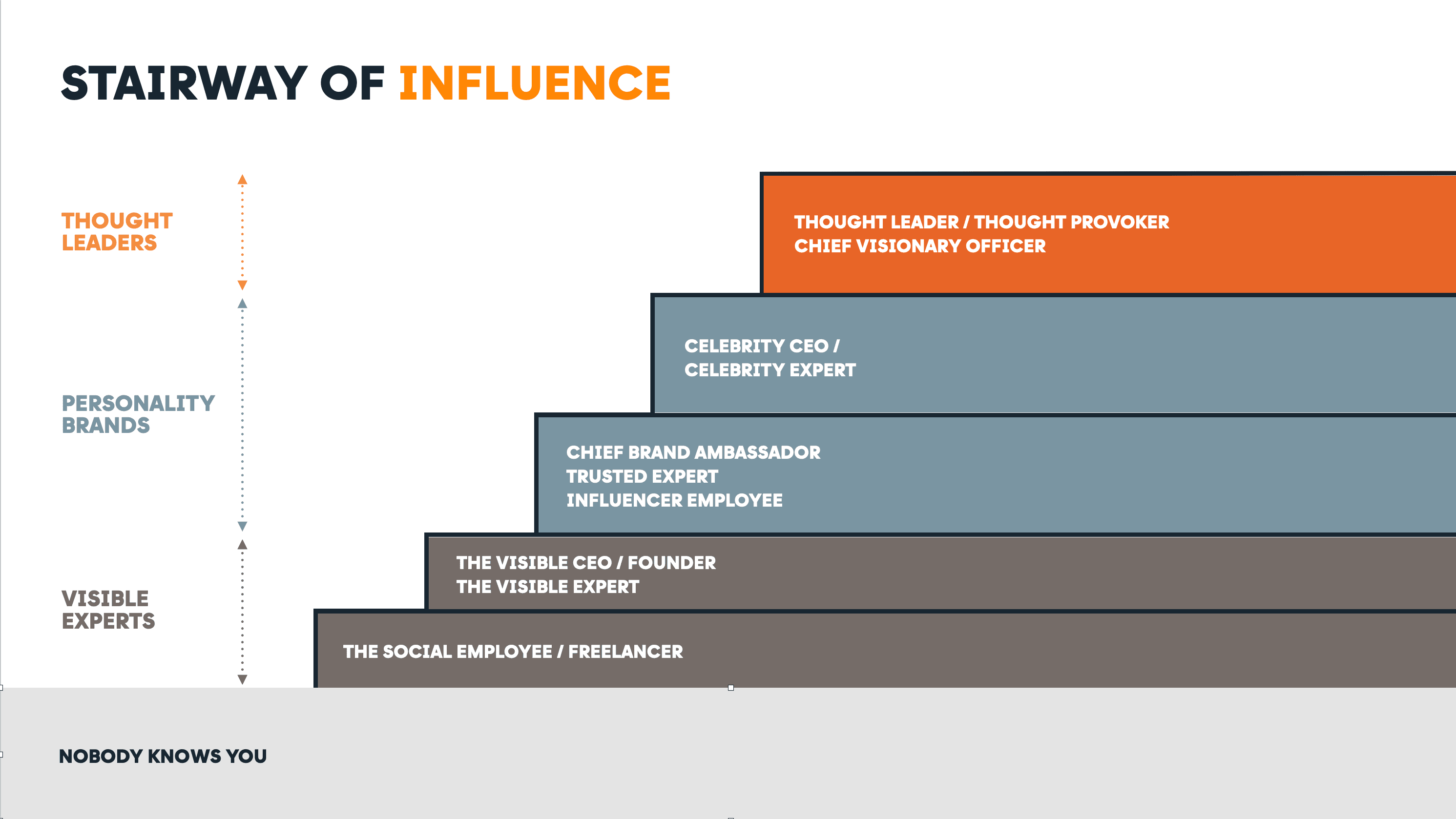
In my book Own Your Story, Or Someone Else Will (2023), I developed the Stairway of Influence — a model that maps five levels of professional visibility and influence, from “nobody knows you” to thought leader. The stairway runs through the social employee, the visible expert, the trusted authority and brand ambassador, the celebrity CEO, and finally the thought leader, thought provoker, or chief visionary officer.
The model was designed to make one thing visible: the jump from level four to level five is not incremental. It is categorically different. The first four levels are about increasing visibility within a field. The fifth level is about shifting the field itself.
What I have observed since is that the term “thought leader” has migrated downward. It is now routinely applied at level two and three — to the visible expert who publishes regularly, to the trusted authority who speaks at conferences and gets cited by peers. Their audience calls them a thought leader. Their clients call them a thought leader. And because the label feels earned — they have done the work, they have built the audience, they have developed original thinking — they build their positioning around it.
But their authority operates within the existing paradigm. They make it clearer, sharper, more usable. They are the best voice within the consensus. That is Navigator authority — and it is genuinely valuable. It compounds through adoption, through citation, through the frameworks others use. It is not, however, paradigm-shifting in the sense that the original term described.
The Stairway makes the structure visible. The Authority Archetype Mix™ names the signal. Together, they explain why a professional can be widely respected, frequently cited, and publicly visible — and still feel like something in their positioning does not quite fit. The positioning is built for level five. The authority signal operates at level three. That gap is not a failure. It is a misidentification.
Most professionals at level three and four are Navigators, Guardians or Bridge Builders. Their authority is real, compound-building and durable. The work is not to push them toward level five. It is to build their public authority from the signal they actually carry — so that the positioning fits, the communication lands, and the authority stops requiring constant recalibration.
Why claiming the title makes it worse
The industry that has grown around the term treats thought leadership as a deliverable. Marketing agencies sell “thought leadership packages.” Ghostwriters promise to position you as a thought leader in ninety days. The premise is that the title is a matter of output volume — publish enough, appear in enough places, and the standing follows.
It does not. A borrowed voice producing polished commentary under your name builds nothing that compounds, because the audience senses the gap between the writing and the person behind it. And the deeper problem is not the ghostwriting. It is that the entire apparatus is built to manufacture a signal you may not actually carry.
Building your authority from the wrong archetype produces friction that never resolves. If you are a Navigator — someone whose authority comes from making complexity legible — and you perform the Trailblazer signal because that is what “thought leadership” looks like, you will spend years in a performance that never compounds. The ideas will be good. The delivery will feel borrowed. And the authority you actually carry will remain unnamed and unbuilt.
The three forms of Trailblazer authority
Not every Trailblazer operates in the same way. What they share is the paradigm-shifting effect — their work does not contribute to the existing conversation but changes the conversation itself. How they achieve it differs. And so does the degree of empathy their authority requires.
This last point — empathy — is the most overlooked dimension of thought leadership. The three variants sit on a gradient from high empathy to near-zero empathy for the present moment. Where you sit on that gradient determines how your authority needs to be built.
The Product Thought Leader
High empathyDevelops a method, framework or model that achieves widespread adoption and changes how an industry operates — paradigm-shifting not because it is provocative but because it is usable. This variant requires the highest empathy of the three: a framework that changes a field must first meet people where they are, understanding the current pain deeply enough to build the bridge between the old paradigm and the new one. Without that empathy, the framework stays theoretical — admired from a distance but never adopted.
The Thought Provoker
Strategic empathyDoes not necessarily build a product or a method. They dismantle an assumption — and their authority comes from the provocation itself, the moment an audience realises that what they believed was incomplete, outdated or wrong. Their empathy is strategic rather than connective: they know exactly where the audience's thinking is stuck and which single argument will fracture it, but they do not accommodate the discomfort that follows. They confront rather than comfort. That is the source of their authority and the reason their work polarises.
The Visionary Executor
Minimal empathySees a radically different future and builds it — whether the present is ready or not. This variant has the least empathy for the current reality: they do not meet people where they are, they pull people toward where they are going. Their authority requires execution, because vision without building is speculation. The Visionary Executor who delivers becomes undeniable. The one who only talks becomes the Isolated Visionary — the shadow of the Trailblazer archetype.
Sally Hogshead's Fascinate system is a Product Thought Leader example. She did not merely offer a personality assessment — she reframed how professionals understand differentiation, grounded in branding science rather than psychology. More than a million professionals adopted it. That is not thought leadership as commentary. It is thought leadership as infrastructure.
Nassim Taleb's work on antifragility is a Thought Provoker example. He did not offer a method for managing risk. He dismantled the assumption that stability is the goal — arguing that systems and people benefit from certain kinds of stress and disorder. The argument did not make people comfortable. It made them rethink an entire orientation toward uncertainty. That rethinking is what makes it Trailblazer territory rather than Navigator territory.
The empathy gradient — and why it matters for positioning
The Product Thought Leader operates from high empathy. They understand the current pain so well that they can build the bridge between present and future. Their writing is accessible, their frameworks are adoptable, and their authority grows through the usability of their work. If your natural mode is to build tools people can use — to translate your thinking into something operational — this is your variant.
The Thought Provoker operates from strategic empathy. They understand the current thinking well enough to know exactly where to place the charge. Their writing is confrontational, their arguments are uncomfortable, and their authority grows through the debates they trigger. If your natural mode is to challenge the consensus that no one else is naming — this is your variant.
The Visionary Executor operates from minimal empathy for the present. They do not explain, they do not accommodate, they build. Their authority grows through the undeniable reality of what they create. The most effective Visionary Executors pair with a Navigator who translates their vision into language the present can absorb.
Most professionals who aspire to thought leadership are naturally positioned in the first variant — and there is nothing lesser about that. The Product Thought Leader produces work that changes how people operate. The empathy that makes their frameworks usable is a strength, not a compromise.
What this means if you are not a Trailblazer
The most important implication of this framework is not for the professionals who carry the Trailblazer signal. It is for the ones who do not — and who have been trying to build authority as if they do.
The majority of experienced professionals who develop original thinking, build methodologies and publish their ideas are Navigators. Their authority comes from making complexity legible — from creating frameworks that help people operate better within the current paradigm. That is genuinely valuable work. It compounds. It builds a body of work that others cite and adopt.
But it is not thought leadership in the paradigm-shifting sense. And performing the Trailblazer signal when your dominant authority is Navigator produces a specific, recognisable friction: the ideas are good but the positioning feels inflated. The contrarian takes attract attention but the authority does not stick. The speaking engagements generate applause but not the kind of following that compounds.
The resolution is not to lower ambition. It is to build from recognition rather than aspiration. The Navigator who builds authority from their actual signal — structured sense-making, intellectual property, adopted frameworks — compounds faster and more durably than the Navigator who performs the Trailblazer.
Building from the signal you actually carry
When you build from the archetype you genuinely hold, the calibration stops. There is no gap to maintain between the authority you perform and the authority you carry, because they are the same. The work stops feeling borrowed.
The authority travels. A position built from recognition rather than aspiration holds across contexts without recalibration — in a keynote, in a boardroom, in a written argument. And the body of work compounds: each new piece reinforces the standing rather than diluting it, because every contribution is made in the signal that is actually yours.
That distinction — between the authority you aspire to and the authority you actually carry — is the foundation of the Authority Archetype Mix™. The Congruence Wheel™ inside the Authority Brand Blueprint is designed to surface it.
The next step
The Authority Archetype Mix™ is one of the proprietary tools inside the O.W.N® Practice. It is used in the Authority Brand Blueprint — the foundational program for professionals ready to build authority from the signal they already carry.
If you recognise the friction of performing a signal that is not yours, the Authority Mindset Audit is the place to begin — a €47 diagnostic that maps where you currently stand across the dimensions of professional authority. It takes thirty minutes. The results arrive in five.
Take the Authority Mindset Audit →Common Questions
Questions about thought leadership and the Trailblazer
- What does thought leadership actually mean?
- Thought leadership, in its original sense, means work that shifts a paradigm — that changes how a field thinks, operates or understands itself. It is not publishing frequently or speaking at conferences. It corresponds to the Trailblazer archetype: someone whose work does not contribute to the existing conversation but changes the conversation itself.
- What is the Trailblazer archetype?
- The Trailblazer is the archetype in the Authority Archetype Mix™ that carries genuine thought leadership — paradigm-shifting authority. It has three variants on an empathy gradient: the Product Thought Leader (high empathy), the Thought Provoker (strategic empathy) and the Visionary Executor (minimal empathy for the present). Each builds authority differently.
- What is the difference between a Trailblazer and a Navigator?
- A Trailblazer changes the paradigm; a Navigator makes the existing one legible. The Navigator's authority comes from structured sense-making — frameworks that help people operate better within the current model. It is genuinely valuable and it compounds, but it is not thought leadership in the paradigm-shifting sense. Most experienced professionals are Navigators.
- How do I know if I am actually a thought leader?
- Ask whether your work changes how your field operates or whether it helps people operate better within how the field already works. The first is Trailblazer authority; the second is Navigator authority. Performing the Trailblazer signal when you are a Navigator produces friction that never resolves — the ideas are good but the positioning feels inflated.
The Authority Archetype Mix™ is a proprietary framework owned by ianka fleerackers CommV, built on and used inside the O.W.N® practice — Ownership, Wisdom, Narrative — a registered trademark of ianka fleerackers CommV. Unauthorised use, reproduction or adaptation of this framework or methodology is prohibited.
© 2026 ianka fleerackers CommV. All rights reserved.