The Triangle of Fear Mastery™
The Three Fears That Keep Capable Experts Quiet
Most professionals who hesitate to share their thinking publicly do not have a confidence problem. They have an undiagnosed fear structure. The Triangle of Fear Mastery™ names it.
By ianka fleerackers
You have built something substantial. Decades of work. Hard-earned judgment. A perspective on your field that is genuinely yours.
And yet — when it is time to make that perspective public, something stops you. Call it a fear of sharing opinions publicly, a fear of standing out at work, or a fear of being misunderstood — the labels vary, but the result is the same: silence where there should be a voice.
You rewrite the post six times and publish none. You hold back your real position in the meeting and offer the diplomatic version instead. You watch colleagues with half your depth occupy twice the visibility, and you tell yourself the timing is not right. Not yet. Not now. A little more preparation first.
This is not a confidence problem. It is a fear structure — and it has a name.
Why the usual fixes fail
The standard advice for professionals who hesitate to speak publicly falls into two camps.
The first is confidence coaching. Build your self-belief. Practise positive self-talk. Visualise success. Reframe your inner critic. The assumption: you are holding back because you do not believe in yourself enough. The prescription: believe harder.
The second is the exposure school. Just post more. Get on more stages. Start a newsletter. The assumption: fear dissolves through repetition. The prescription: do the thing you are afraid of, often enough, until you stop being afraid.
Both approaches treat the symptom. Neither touches the structure. The professional who forces themselves onto a stage without first grounding what they actually stand for will perform confidence — and feel hollow. The professional who writes more without resolving what they genuinely think will produce volume — and wonder why none of it compounds into authority.
There is a reason so many capable experts invest in presentation skills, hire ghostwriters, take course after course — and still feel stuck. They are working on the wrong layer. The Triangle of Fear Mastery™ I developed inside the O.W.N® practice names the actual structure underneath — and it changes the order of operations entirely.
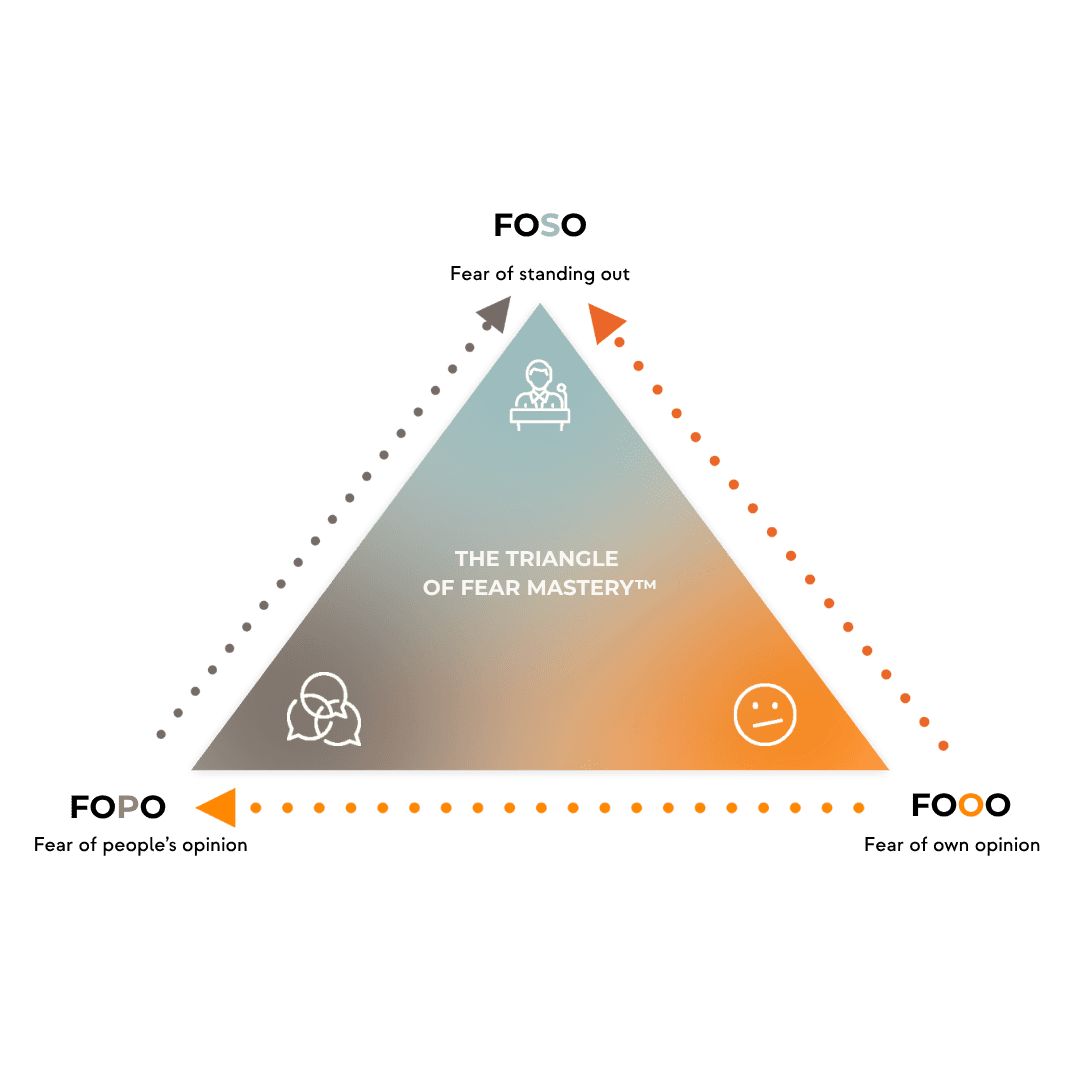
The Triangle of Fear Mastery™ — a structure, not a confidence gap
Three fears govern how professionals communicate publicly. They are distinct, they interact, and — this is the part most people have never considered — they are hierarchical. If you are working on the wrong one, you will not resolve the other two.
The Triangle maps them in order.
Fear of Other People's Opinion
FOPO · the visible oneThe most recognised fear. The one everyone talks about. FOPO is the reason you soften your position before publishing. The reason you scan the room before stating what you think. The reason you filter every piece of professional communication through a single question: will this be accepted?
What makes it particularly corrosive for authority is that it does not prevent you from communicating. It makes you communicate cautiously. Over time, that caution erodes the sharpness of your professional voice. You sound reasonable. Safe. Measured. But not like someone with a body of work worth following.
Most professionals who recognise themselves here assume FOPO is their primary problem. It rarely is. It is the most visible fear, not the most foundational one.
Fear of Standing Out
FOSO · the rationalised oneBroader than stage fright. FOSO is the discomfort of being seen — fully, publicly, without the protection of a role, a title, or an institution. It is the fear of standing out at work in its purest form, and it has two faces.
The first is the fear of failure: what if I stand out and fall flat? This is what keeps professionals from accepting the keynote, from publishing the essay, from taking the public position their expertise has earned. The second is subtler and far more common among senior professionals — the fear of success: what if it works, and more is expected than I can sustain? The exposure. The scrutiny. The permanence of a position that cannot be easily retracted.
FOSO is also the fear most effectively rationalised. “I do not have time for this.” “The moment is not right.” “I should prepare more thoroughly.” These are not reasons. They are sophisticated avoidance — the kind you recognise instantly in others and struggle to see in yourself.
Fear of Own Opinion
FOOO · the foundationThe least discussed fear — and the one that governs the other two. It takes two forms. The first: you have a strong opinion, but you believe your environment is not ready for it, so you hold it back and say something safer. Every time you do, your voice gets thinner.
The second is more common than most professionals expect. You observe what others in your field are doing and find it insufficient. Shallow. Derivative. And yet you are not on that stage yourself. The question operating beneath the surface is: what if I am right about them, but I cannot do it better? That question keeps more professionals silent than any external criticism ever could.
FOOO is the domino. When you genuinely know what you think — grounded not in impulse but in accumulated expertise and tested conviction — FOPO becomes manageable. Criticism becomes a conversation, not a threat. And FOSO becomes irrelevant: the exposure is no longer about you, it is about the intellectual weight you are carrying. The shift is not from fear to fearlessness. It is from managing fear to rendering it structurally irrelevant.
This is why the order matters. Most professionals have spent years working on the top of the Triangle — learning to handle criticism, forcing exposure — while the fear at the base goes untouched. The work starts at the bottom and moves up. Resolve your relationship to your own opinion, and the two fears above it lose most of their force. Not because they disappear. Because they stop governing your decisions.
What the Triangle of Fear Mastery™ produces
When the foundation is in place, the change is not that you become fearless. It is that fear stops setting the agenda.
What that looks like in practice: a professional who publishes because they have something worth saying, not because the algorithm demands consistency. A founder who takes a public position because it is grounded in conviction, not because a coach told them to show up. An expert whose authority compounds over time because it was built on substance, not on managed perception.
For professionals at an inflection point — where their standing has not caught up with what they have built — the Triangle names what is actually in the way. For those building across multiple companies, projects and ideas — the portfolio career that reads as scattered from the outside — it explains why articulating a through-line feels so exposing. It is not the complexity. It is the fear of claiming a position that spans all of it.
Where the Congruence Wheel™ maps whether your outer expression matches your substance, the Triangle of Fear Mastery™ addresses what stops you from expressing it at all. It does not replace the work of building a body of work. It removes the structural obstacle that keeps the work from becoming visible.
The next step
If you recognised the structure described here — not as an interesting idea but as a precise description of something you have been living — the question is not whether you need to work on this. The question is whether this is the right moment.
The Triangle of Fear Mastery™ is one of the proprietary tools inside the O.W.N® Method. It is used in the Authority Blueprint — the foundational program for professionals ready to build authority from the inside out.
Common Questions
Questions about the Triangle of Fear Mastery™
- What is the Triangle of Fear Mastery™?
- The Triangle of Fear Mastery™ is a proprietary framework developed by ianka fleerackers inside the O.W.N® practice. It names the three fears that keep capable experts quiet — Fear of Other People's Opinion, Fear of Standing Out, and Fear of Own Opinion — and shows that they are hierarchical, not a single confidence gap.
- Is the fear of sharing opinions publicly a confidence problem?
- Rarely. The fear of sharing opinions publicly is usually structural, not a lack of nerve. Beneath it sits an unresolved relationship to your own thinking — the Fear of Own Opinion. Building confidence treats the surface; the Triangle of Fear Mastery™ works at the layer that actually governs whether you speak.
- What causes the fear of standing out at work?
- The fear of standing out at work has two faces: the fear of failing publicly, and the subtler fear of succeeding and being unable to sustain the exposure. Both are most often rationalised as bad timing. The Triangle of Fear Mastery™ shows why working on exposure directly rarely resolves either one.
- How do I stop the fear of being misunderstood from keeping me quiet?
- You do not resolve the fear of being misunderstood by communicating more carefully — caution only thins your voice. It eases when you ground what you actually think, so criticism becomes a conversation rather than a threat. The Triangle of Fear Mastery™ starts there: with your own opinion, not other people's.
The Triangle of Fear Mastery™ is a proprietary framework owned by ianka fleerackers CommV, built on and used inside the O.W.N® practice — Ownership, Wisdom, Narrative — a registered trademark of ianka fleerackers CommV. Unauthorised use, reproduction or adaptation of this framework or methodology is prohibited.
© 2026 ianka fleerackers CommV. All rights reserved.