The Congruence Wheel™
Why Your Positioning Feels Like a Costume
Most professionals build authority from the outside in — and spend years maintaining a position that never quite fits. The Congruence Wheel™ maps where the alignment breaks down.
By ianka fleerackers
You have the expertise. The track record is real. The thinking is there. And yet — something does not land.
You adjust your opinion depending on the audience. You hesitate before taking a public position. You feel the gap between what you know you are capable of and what the world actually sees. Your expertise is real, but it does not translate publicly — you are known in the room and somehow invisible beyond it. The professionals around you seem to carry their authority without effort. Yours requires constant calibration.
This is not a confidence problem, and it is not a visibility problem. And it is not something that another round of positioning work will fix either.
It is a congruence problem — a structural misalignment between what you actually stand for and what the world perceives. And until you see where the misalignment sits, every attempt to close the gap will feel like putting on someone else's clothes.
Why the usual fixes make it worse
The standard approach to professional positioning starts from the outside: how do I want to be perceived? What should my message be? How do I differentiate myself? These are not wrong questions. They are the wrong starting point.
Personal branding makes you visible — a valuable first step. But when it starts only from the image you want to project, the position needs constant upkeep. You monitor how it lands. You adjust when the audience shifts. You rebuild it when your role or your offer changes. And the friction you feel every time you publish, speak or introduce yourself is the distance between the projected image and the actual substance underneath — the gap authority branding closes.
Coaching offers confidence as the remedy — as if the problem were insufficient nerve rather than insufficient alignment. You learn to speak with more authority, present with more presence, take up more space. The delivery improves. The underlying structure does not. And the feeling that something is off persists, because the something is not in how you communicate. It is in what you are communicating from.
Ghostwriting solves the output problem without touching the source. Someone else produces polished thinking under your name. The voice sounds professional. It does not sound like you — because it cannot. A borrowed voice carries no weight over time. The audience may not be able to name why, but they sense the gap between the writing and the person behind it.
Each of these approaches treats the symptom. None of them diagnoses the system.
The Congruence Wheel™ — a diagnostic, not a strategy
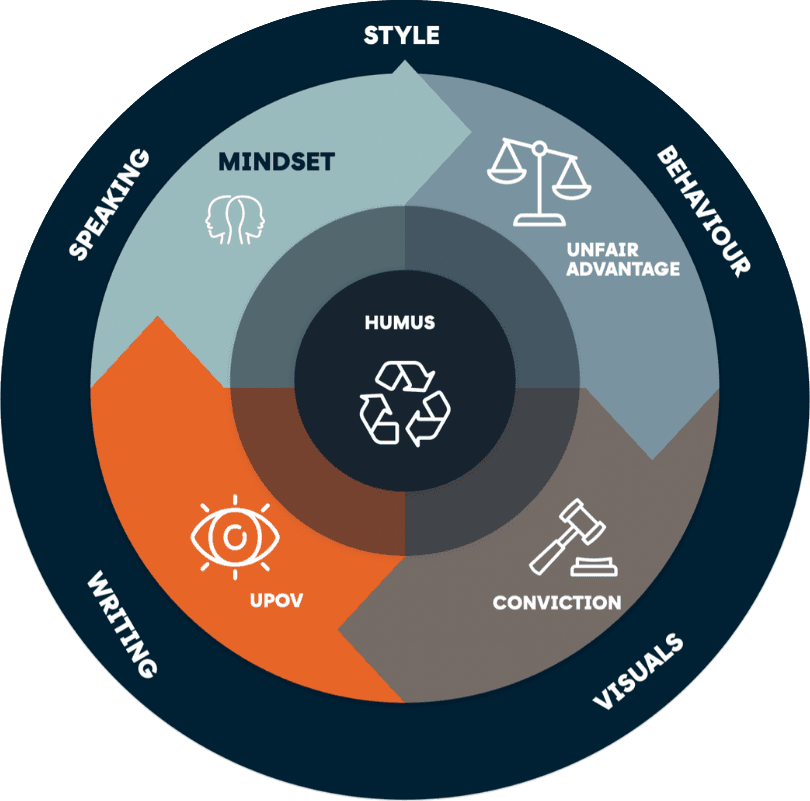
The Congruence Wheel™ is the diagnostic tool I developed inside the O.W.N® Practice to map that system. It does not ask what image you want to project. It asks where the alignment between your inner substance and your outer expression is strong — and where it breaks down.
The Wheel maps six elements.
Humus
The centreThe accumulated foundation of your knowledge, skills and expertise. It is where most professionals stop when asked what makes them valuable — but it is only the starting point. Others know what you know. If your authority rests entirely on your Humus, you are competing on a layer where differentiation is shrinking.
Mindset
DifferentiationHow you relate to challenge, to visibility, and to your own convictions.
Unfair Advantage
DifferentiationThe non-replicable combination of circumstances, assets and characteristics that is structurally yours — not something you trained for.
Conviction
DifferentiationNot the values you list, but the values you have defended when it cost you something.
UPOV
DifferentiationYour Unique Point of View — the particular lens through which you see your field that makes people come to you for perspective, not just for expertise.
Style
The outer ringNot aesthetics. Not performance. Style is how the inner elements become legible to the world, expressed through four channels — Speaking, Writing, Behaviour and Visuals.
When Style genuinely reflects what sits beneath it, you have congruence. Your authority does not require effort. It is carried by the consistency between what you think, what you believe, and how you show up. People trust it — not because you tell them to, but because they sense that the signal is the same in every channel.
When it does not — when your Style is thinner, softer or more generic than your actual substance — you have friction. And that friction is what most professionals feel when they hesitate before publishing, when they soften their position in a meeting, when they hold back the thing they actually think and say something safer instead.
What this looks like in practice
Consider two professionals with similar expertise, similar credentials, similar years of experience.
The first has done the positioning work from the outside in. She has a clear message, a professional visual identity, a content strategy. But in conversation, something shifts. The public version is polished. The private version is sharper, more opinionated, more interesting. She knows it. She adjusts constantly — toning down in one context, performing confidence in another. Her authority looks right. It does not feel right. And the energy required to maintain the gap is considerable.
The second has never done formal positioning work. But she knows what she thinks. Her convictions are tested — she has defended them when it was inconvenient. Her point of view is recognisably hers — people can predict what she will say about a new development in her field, not because she is predictable, but because her intellectual framework is consistent. When she speaks, writes or presents, the signal is the same. There is nothing to maintain. The alignment is structural.
The difference between them is not skill. It is not even substance — both have real expertise. The difference is congruence. The first is managing a position. The second is inhabiting one.
The Congruence Wheel does not build you a new position. It shows you where the one you already have is misaligned — and where it holds. The gaps are the work. The alignment is the foundation.
Two applications — one diagnostic
The congruence question operates at two scales.
At the inflection point
A professional whose career is shifting — from operator to advisor, from expert to public authority, from one domain to another. The old positioning no longer fits. The new one is not yet articulated. The Congruence Wheel maps where the substance has already moved and where the expression has not caught up. It closes the gap between private authority and public standing. This is the work at the centre of the Authority Fingerprint™.
Across a portfolio career
A professional building across multiple companies, projects and bodies of work. The problem is not lack of expertise in any single domain. It is the absence of a through-line — a narrative that holds everything together and makes it coherent to the outside world. The Congruence Wheel surfaces the thread that connects the portfolio. It is always there. It has simply never been articulated. The professional who has been told they look like a generalist discovers they are not scattered — they are building something with an architecture that nobody, including themselves, had made visible. This is the terrain of Longevity Career.
Both applications use the same diagnostic. The question is the same: does what the world sees match what actually exists? The scale is different — one career in transition, or a body of work across decades. The method holds in both cases because congruence is structural. It does not depend on the number of projects. It depends on the alignment between them.
What congruence produces
Professionals who have done this work describe the outcome in remarkably similar terms.
The constant calibration stops. The energy previously spent adjusting is no longer necessary. Not because they have learned to perform consistency. Because they have located it.
The authority travels. A position built from congruence does not require a specific context to carry weight. It holds in a keynote, in a boardroom, in a written argument, in a conversation that changes something. The substance is the same in every channel. The expression adapts. The signal does not.
The body of work compounds. Instead of each new project, each new chapter, each new piece of thinking starting from scratch, it builds on what came before. The through-line is visible — to the professional and to the people around them. Every new piece of work reinforces the existing authority rather than diluting it.
And the positioning stops feeling like a costume. It becomes something they recognise as genuinely theirs — not manufactured, not borrowed, not performing. Built from the inside out. Grounded in substance that has been articulated, tested and expressed with precision.
Congruence is not a destination
The Wheel moves. As your thinking evolves, your convictions deepen, your context changes, your point of view sharpens — the elements shift. The professional who was congruent at thirty-five may not be congruent at forty-five. Not because they regressed. Because they grew and their expression did not keep up.
That is why this model is a wheel and not a ladder. There is no final state. There is only the ongoing question: does what the world sees still match what I actually stand for?
The professionals whose authority compounds over decades are not the ones who found their position once and held it. They are the ones who kept checking — who treated congruence as a practice rather than an achievement. Who understood that the Wheel moves, and that their job is to move with it.
The next step
The Congruence Wheel™ is one of the proprietary tools inside the O.W.N® Practice. It is used in the Authority Fingerprint™ — the foundational program for professionals ready to build authority from the inside out — and in Longevity Career, the bespoke engagement for those building across multiple bodies of work.
Common Questions
Questions about the Congruence Wheel™
- What is the Congruence Wheel™?
- The Congruence Wheel™ is a proprietary diagnostic developed by ianka fleerackers inside the O.W.N® practice. It maps six elements — Humus, Mindset, Unfair Advantage, Conviction, UPOV and Style — to show where the alignment between a professional's inner substance and outer expression is strong, and where it breaks down. It diagnoses a position; it does not manufacture one.
- Why does my positioning feel fake even though my expertise is real?
- Because the friction is not a confidence or visibility problem — it is a congruence problem. When your outer expression (Style) is thinner, softer or more generic than your actual substance, you feel the gap every time you publish or speak. The fix is not more positioning work from the outside in; it is closing the structural misalignment between what you stand for and what the world sees.
- How does the Congruence Wheel™ relate to personal branding?
- Personal branding makes you visible. The Congruence Wheel™ makes that visibility hold. It surfaces what is already true — your background, convictions and point of view — so the brand you build rests on consistency rather than on an image that has to be maintained. That is the step from personal branding to authority branding: a position that carries over when your role, your offer or your company changes.
- Why my expertise doesn't translate publicly — what is actually missing?
- Usually nothing is missing from your expertise. What is missing is congruence between that substance and how it becomes legible to others. Known in the room but invisible beyond it is the signature of a misaligned outer ring: the thinking is there, but the expression has not caught up with it. The Congruence Wheel™ locates exactly where.
The Congruence Wheel™ is a proprietary framework owned by ianka fleerackers CommV, built on and used inside the O.W.N® practice — Ownership, Wisdom, Narrative — a registered trademark of ianka fleerackers CommV. Unauthorised use, reproduction or adaptation of this framework or methodology is prohibited.
© 2026 ianka fleerackers CommV. All rights reserved.